Open the exact family listing to compare the live price, availability, delivery, seller, and returns.
Choose cabinet and drawer locks by the hazard being restricted, door and frame geometry, mounting method, current ASTM and recall context, pull resistance, small parts, adult access, automatic re-engagement, emergency needs, inspection, and layered storage.
Prepared by the NestCheck Picks editorial deskUpdated August 10, 2026
Quick answer
The practical answer
Move poisons, medicines, batteries, and sharp objects high and locked first, then add a latch that fits the exact door or drawer and re-engages every time. Look for current ASTM F3492 information and recall status, follow the mounting and cure instructions, pull-test it regularly, and store magnetic keys inaccessible to children. No lock is completely childproof or a substitute for supervision.
Common buying question
Which childproof cabinet lock should I buy for cleaners, medicines, knives, and drawers without relying on one latch?
Existing nursery gear pages do not decide hazardous-item storage, automatic latching, magnetic-key custody, adhesive cure, screw mounting, current ASTM F3492, or pull-test inspection.
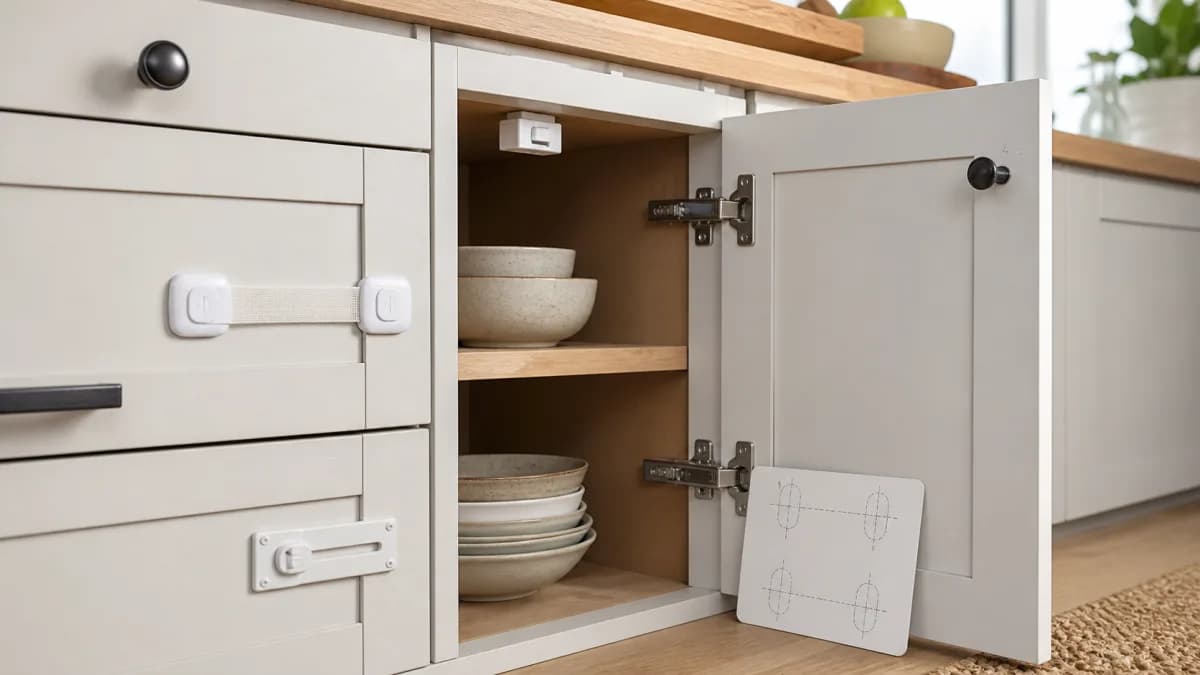
Original editorial image for category, fit, and use context; verify the exact linked product appearance and configuration on the retailer page.
Map hazards before buying latches
Open every child-accessible cabinet, drawer, bag, and trash container. Move medicines, cleaners, detergent packets, batteries, matches, knives, and other serious hazards high, out of sight, and in appropriately locked storage. A cabinet latch adds delay; it does not make dangerous contents safe. Firearms, medicines, and poisons may require dedicated secure storage beyond a consumer child-safety latch.
Fit the moving door and fixed frame
Identify inset or overlay doors, frameless cabinets, paired doors, drawer slides, handle position, and internal obstructions. Hold the exact latch in the intended location and confirm full engagement across normal closing tolerances. A device that catches only when the door is pushed sideways or slammed is not reliably installed. Do not modify the latch outside its instructions to force a fit.
Treat adhesive preparation and cure as structural steps
Use the cleaning method, temperature, surface restrictions, pressure, and cure time specified by the maker. Paint, grease, textured laminate, humidity, damaged veneer, and repeated pulling can weaken adhesive. Screw-mounted products avoid some adhesive limits but can damage furniture and still require precise alignment. Keep the cabinet unavailable to children until installation is complete and tested.
Prefer automatic re-locking and inaccessible keys
The safest routine is one the adult can complete every time: close the door and verify the latch engaged. Magnetic keys should be stored where children cannot see, reach, or imitate their use, but adults and caregivers can access them. Never leave a magnetic key attached outside the cabinet. If frequent use leads adults to disable a latch, change the storage plan or product.
Pull-test and recall-check regularly
CPSC warns that no device is completely childproof. On a schedule, inspect alignment, adhesive edges, screws, plastic wear, detachable small parts, and automatic engagement, then apply a firm adult pull without damaging the furniture. Stop using failed or recalled hardware immediately and follow the remedy. Supervision and keeping hazards out of reach remain necessary after every lock is installed.
Current Amazon option
Check this exact product
Safety 1st Adhesive Magnetic Lock System with Eight Locks and Two Keys
ASIN
B076QN2V4Q
Brand
Safety 1st
Listing checked
8/10/2026
Compare the current title, ASIN, variant, seller, stock, shipping, price, and return path before ordering.
Exact Safety 1st adhesive magnetic system anchor; verify model, pack, instructions, standard claim, recall status, seller, and availability.
Public owner context
Questions to answer before buying
Community discussions help surface installation, fit, maintenance, and failure questions. They are anecdotal context, not product specifications or a substitute for current instructions.
Used to identify recurring concerns about adhesive strength, alignment, magnetic keys, and long-term engagement; anecdotes do not establish safety compliance.
How this page was governed
Page-specific editorial method
1.Inventory each cabinet's contents and relocate the highest-consequence hazards before selecting hardware.
2.Measure the exact door and frame, follow cleaning, placement, cure, and mounting instructions, then adult pull-test.
3.Verify current ASTM F3492 claims and search CPSC recalls for the exact model and pack before purchase and publication.
4.Inspect and re-engage locks routinely, keep keys and small parts inaccessible, and maintain direct supervision.